 Instant Access After Purchase


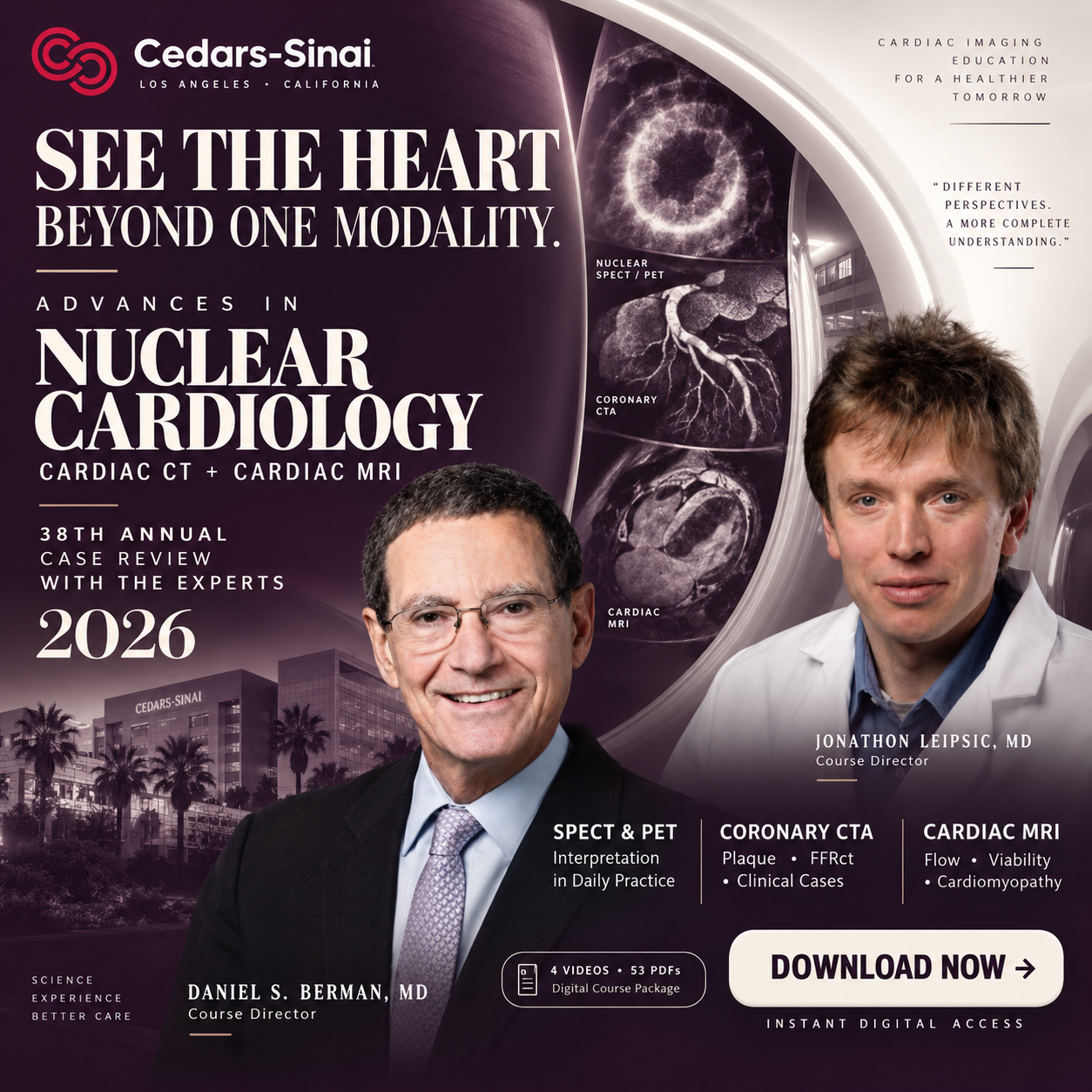
+ Include: 4 videos + 53 pdf, size: 6.07 GB
+ Target Audience: cardiologists and radiologists
+ Information:
Friday, January 23, 2026, 7:30 AM – Sunday, January 25, 2026, 2:55 PM PT, Cedars-Sinai Harvey Morse Conference Center, Los Angeles, CA
Target Audience
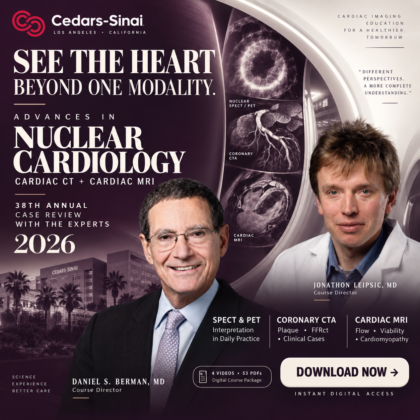
A major national healthcare imperative for noninvasive imaging is for the tests to provide value. Nuclear cardiology and cardiac CT studies provide powerful tools for diagnosis, risk assessment, and guiding management of selected patients with known or suspected cardiac disease. In the current environment, imaging must address the combined considerations of improving outcomes and containing costs. To this end, advanced cardiac imaging studies must be ordered on the right patients and optimally performed, interpreted, reported, and acted upon by physicians and allied health professionals. Additionally, effective methods to reduce radiation exposure need to be implemented to maximize patient safety. There is a clear need for physicians ordering, performing and interpreting the tests to understand the issues regarding value-based imaging and to optimally implement this understanding. We meet these educational needs through a live activity entitled: Advances in Nuclear Cardiology, Cardiac CT and Cardiac MRI: 38th Annual Case Review with the Experts. The course is designed to meet the current needs of professionals who perform or request nuclear cardiology or cardiac CT. The course covers the use of these modalities across the spectrum of patients routinely seen by cardiologists in typical day-to-day practice and is designed to improve ordering patterns and increase quality in performing, interpreting, reporting and applying the advanced imaging methods. A unique feature of the program is the extensive use case presentations of each subject as a proven effective teaching tool. It also includes multiple sessions with group faculty discussions. There is a focus on incorporating new guidelines in practice and the latest evidence from clinical trials and registry findings
- Identify up to date evidence regarding the information provided by tests, the appropriate use of testing an how the tests affect outcomes an costs in coronary and noncoronary heart and aortic disease
- Recognize the implications of 2019 ESC CTA ACCAHA chest pain guidelines on the use of noninvasive testing
- Implement the latest acquisition processing protocols, instrumentation and software for multiple imaging modalities
- Explain how new approaches to functional assessmentsuch as coronary flow reserve, noninvasive fractional flow reserve, and plaque measurementsenhance the information obtained from testing.
- Improve image interpretation and recognition of image artifacts
- Recognize strategies tor educe patient radiation and contrast exposure while conduct high quality studies
- Apply optimal protocols for pharmacologic stress testing
- Create optimal reports that integrate test findings and provide guidance for patient management
- Identify the latest information regarding how test findings should be used to guide patient management decision
- Use criteria and evidence based strategies to reduce inappropriate testing
- Identify knowledge gaps regarding blueprints for the CBNC and CBCCT Boards
Topics :
-
AI in Cardiac CTA- Quantification of Coronary Plaque- Prediction of Risk-Prediction, and Ischemia
-
Amyloid Quantitation- Decreasing Subjectivity in PYP Interpretation
-
Amyloid Specific PET Tracers
-
Beyond Perfusion with MPI- AI Analysis of CAC, Chamber Volumes, Epicardial Fat, Body Composition and Beyond
-
Beyond the Images- The Essential Role of Excercise and Functional Assessment in Cardiac Testing
-
Cardiac MRI and PET in Microvascular Disease
-
Cardiac MRI in Sarcoidosis and Other Inflammatory Cardiomyopathies
-
Case Review- CTA in Valvular Disease
-
Case-Based Interpretation of Flurpiridaz MPI
-
Central Role of Cardiac CT in Structural Heart Disease
-
Changing the Outlook in Cardiac Amyloidosis- Current and Novel Therapies
-
Choosing Between Flurpiridaz and Rubidium
-
Class IA Guideline Recommendation for Chest Pain- What Evidence Brought Coronary CTA Here
-
Clinical Value of Myocardial Blood Flow Measurement
-
Combining Anatomy and Physiology with SPECT and PET. Crucial Role of CAC Scanning in Patients
-
Coronary Artery Calcium (CAC) Scanning- Central Role in Preventive Cardiology
-
Coronary CT in Mitral Valve and Afib- Watchman and TMVR
-
Coronary CTA and FFRct for the Interventionalist- Use in Planning and Guiding PCI
-
Coronary CTA in Asymptomatic Patients
-
Coronary CTA in Evaluation of Patients with Known CAD (Stents, CABG)
-
Coronary CTA in Evaluation of Suspected CAD in Daily Practice
-
Coronary CTA- Special Consideration for Women
-
Debate- Coronary CTA Will Replace Stress Testing
-
Evolving Trends in CAD- Shifting Risk Factors, Symptoms, and Mortality Drivers
-
FDG PET in Sarcoidosis- Practical Considerations
-
Flurpiridaz- The Ideal PET Perfusion Tracer
-
Game-Show Jeopardy- Cardiac CT, Nuclear, and CMR
-
How to Integrate Stress Myocardial Blood Flow and Flow Reserve in Clinical Reporting and Guiding Therapy
-
How to Start Using Flurpiridaz- Lab Preparation, Protocols, Exercise vs Pharmacologic Stress
-
Incorporating Artificial Intelligence in Interpreting Reports of SPECT MPI- Case Interpretations
-
Integrating Visual and Quantitative Analyses of SPECT and PET- Improving Your Scan Interpretation- Case Illustrations
-
Ischeia Evaluation with Coronary CTA- FFRct
-
MBF-MFR with Cardiac MRI- Becoming Routine in Stress MRI
-
MBF-MFR with PET- How to Perform Quality Control, Interpret and Report
-
MFR with SPECT- Ready for Prime Time-
-
MRI in Cardiac Amyloidosis- Strengths and Limitations
-
My Best Teaching Cases
-
Myocardial Bridging and Coronary Anomalies on Coronary CTA- When is Further Assessement Needed and What Should It Be
-
Myocardial Viability- CMR and FDG PET
-
Nuclear Cardiology in 2026 and Beyond
-
Perfusion and Blood Flow Quantitation- Transmural and Subendocardial
-
PET or SPECT- Right Test for the Right Patient
-
Pharmacologic Stress- Combined with Exercise or Alone- What You Need to Know
-
Plaque Imaging in Guiding Patient Management
-
Problems fo Coronary CTA- Small Stents, CAC, Breathing
-
Putting it All Together- Value-Based Use of Cardiac Imaging
-
Quantitation in Sarcoidosis Interpretation
-
Quantitative Plaque Analysis in Tracking Progression of Disease
-
Stress First SPECT Protocols- Improved Defect Detection, Stress Only Procedures
-
Tc-99m Pyrophosphate (PYP) Imaging- Acquisition, Processing, Interpretation PET-based Radiotracers
-
The Disease, the Suspicion-Diagnostic Pathways, and Treatments
-
The Future of Cardiac CT- Photon Counting CT and More
Reviews
There are no reviews yet.